How to Check Oligo Pool Design Rules Before Ordering
Use this page when you need to decide whether a pool is ready to send to a vendor. Start with the main oligo pool guide first if the application, synthesis method, or vendor-decision path is not settled. It covers the sequence checks that prevent rejections, dropout, amplification bias, and weak representationbefore you place an oligo pool order.
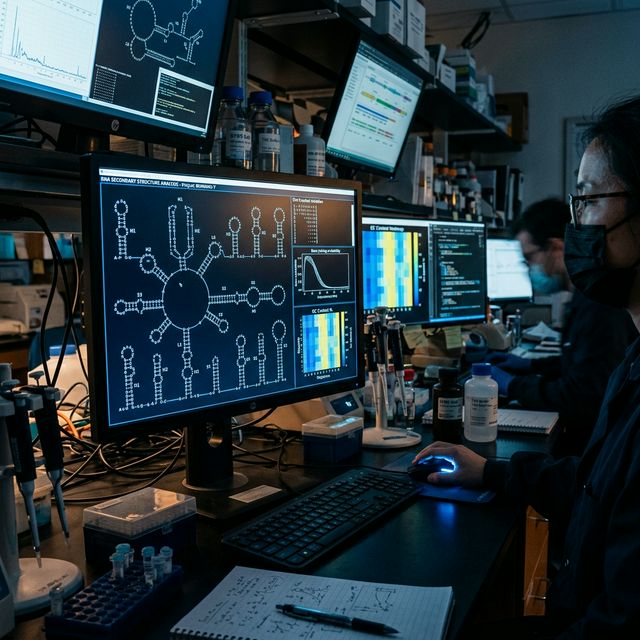
Analyzing DNA hairpins and GC distribution to optimize pool synthesis.
Pre-Order Design Rules Checklist
| Parameter | Optimal Range | Acceptable | Avoid | Impact | Tool |
|---|---|---|---|---|---|
| Oligo Length | 80-150 bp | 60-200 bp | >250 bp | Error rate, full-length yield | Check → |
| Length Uniformity | ±5 bp | ±10 bp | >±20 bp | PCR amplification bias | Check → |
| GC Content | 40-60% | 30-70% | <25% or >75% | Synthesis dropout, PCR bias | Check → |
| Homopolymers | ≤3 nt | ≤4 nt | ≥5 nt (esp. poly-G) | Synthesis errors, deletions | Check → |
| Hairpin ΔG | > 0 kcal/mol | > -3 kcal/mol | < -5 kcal/mol | Synthesis dropout, PCR stall | Check → |
| Repeats | ≤3 bp unit, ≤2 copies | ≤4 bp unit | Long tandem repeats | Replication slippage | Check → |
| Tm Variation | ±2°C | ±5°C | >±10°C | Uneven hybridization | Check → |
| Poly-T Runs | ≤3 consecutive T | 4 T | ≥5 T | Pol III termination (CRISPR) | Check → |
Application-Specific Checks Before Submission
CRISPR Libraries
- →Max poly-T = 3 nt (Pol III terminates at TTTT)
- →Include scaffold sequence (76 bp for SpCas9)
- →Avoid BsmBI/BsaI sites in spacer
- →Add 5' CACCG adapter for BsmBI cloning
NGS Capture Probes
- →Normalize Tm to 65-75°C across all probes
- →Tile 2x (60 bp overlap in 120 bp probes)
- →Add biotin modification specification
- →Avoid >80% homology to off-target regions
Mutagenesis Libraries
- →One oligo per variant (no degenerate codons)
- →Use preferred codons for target organism
- →Include 25-40 bp homology arms for Gibson
- →Add wild-type and synonymous controls
Gene Assembly
- →20-40 bp overlaps with Tm 62-70°C
- →Remove internal restriction sites (BsaI/BsmBI)
- →Add unique amplification primers per gene
- →Codon-optimize for target organism
Pre-Synthesis QC Checks
Run Batch Sequence QC
Upload all sequences. Automatically flags: GC extremes, homopolymers, repeat regions, length outliers.
Use Batch QC →Check GC Content Distribution
Visualize GC% across all oligos. Identify clusters outside 30-70% range for redesign.
Use GC Analyzer →Predict Secondary Structures
Screen for strong hairpins (ΔG < -3). Redesign or flag for vendor attention.
Use Structure Predictor →Normalize Melting Temperatures
Calculate Tm for all oligos. Adjust length or add adapters to bring outliers within ±5°C of median.
Use Tm Calculator →Frequently Asked Questions
What is the ideal GC content for oligo pools?▾
How do I handle oligos with extreme GC content?▾
What secondary structure strength causes synthesis problems?▾
Should all oligos in a pool be the same length?▾
Related Design Rule Pages
Design an Oligo Pool Before Ordering
Review pool design constraints before finalizing sequence architecture.
Read Oligo Pool QC Metrics
Interpret representation, dropout, uniformity, and error-rate reports.
Troubleshoot Oligo Pool Problems
Diagnose dropout, skew, cloning failure, and amplification bias.
Choose Between Array and Column Synthesis
Compare array and column trade-offs before you order.
Open Ordering Checklist
Check file format, IDs, pool size, and submission details.
Run Batch QC Before Ordering
Screen sequence constraints before quote or order submission.