Should You Use Array-Based or Column-Based Oligo Synthesis?
Use this page when you need to choose the right synthesis approach before ordering. Start with the main oligo pool guide first if the pool design, QC expectations, or vendor-decision path is still open. It compares scale, full-length yield, error rate, purification, cost, and downstream handlingso you can decide whether array-based or column-based synthesis fits your project.
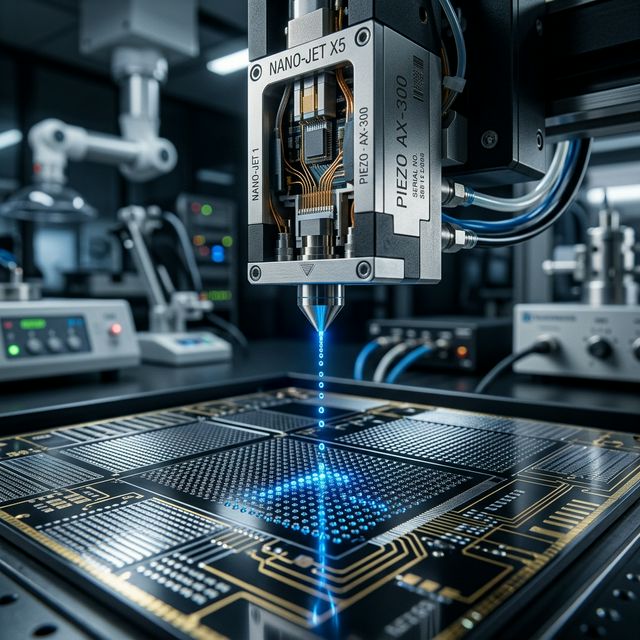
Array-based synthesis utilizing piezoelectric inkjet technology.
Array vs. Column: Which Fits Your Use Case?
| Feature | Array-Based (Pool) | Column-Based (Individual) |
|---|---|---|
| Parallelism | 1K-1M oligos simultaneously | 1 oligo per column (96-384 parallel) |
| Scale/Oligo | fmol-pmol (requires PCR) | 10-1000 nmol (use directly) |
| Coupling Efficiency | 98.5-99.5% per step | 99.0-99.8% per step |
| Error Rate | ~1 per 200 bases | ~1 per 500 bases |
| Full-Length (100-mer) | 30-60% | 70-95% |
| Max Length | 200-350 nt | 100-200+ bp |
| Cost/Oligo | Significantly lower | $5-50 |
| Purification | Pool-level only | HPLC, PAGE per oligo |
| Turnaround | 2-6 business days | 1-3 days |
| Best For | Libraries, pools, high-throughput | Primers, probes, critical sequences |
Which Array Platform Are You Ordering From?
| Technology | Vendor | Mechanism | Capacity | Max Length |
|---|---|---|---|---|
| Silicon-Based Array | Twist Bioscience | Silicon wafer with micro-wells, enzymatic cleavage | Min 2K oligos | 350 nt |
| Inkjet Printing | Agilent SurePrint | Piezoelectric jetting of reagents onto glass slides | Up to 244K/chip | 230 nt |
| CMOS Chip | GenScript GenTitan | CMOS-based electrochemical synthesis on semiconductor chip | Up to 8M/chip | 170 nt |
| Photolithographic | Affymetrix/legacy | UV light through photomasks for deprotection | Up to 1M | ~100 bp |
How Coupling Efficiency Changes Full-Length Yield
| Oligo Length | 98.5% (Low Array) | 99.0% (Good Array) | 99.5% (Best Array) | 99.8% (Column) |
|---|---|---|---|---|
| 50-mer | 47% | 61% | 78% | 90% |
| 100-mer | 22% | 37% | 61% | 82% |
| 150-mer | 10% | 22% | 47% | 74% |
| 200-mer | 5% | 13% | 37% | 67% |
| 300-mer | 1% | 5% | 22% | 55% |
Use our Error Rate Calculator to compute full-length % for your specific oligo length.
Frequently Asked Questions
What is the fundamental difference between array and column synthesis?▾
Why are array-synthesized oligos lower quality?▾
Can array-synthesized pools be used for cloning?▾
Related Synthesis Planning Pages
Read Oligo Pool QC Metrics
Uniformity, error rate, and Gini deep dive.
Check Oligo Pool Design Rules Before Ordering
Review sequence constraints that keep pools synthesis-ready.
Compare Oligo Pool Vendors
Match pool scale, length tier, QC scope, turnaround, and quote terms.
Open Ordering Checklist
Check file formats, ordering constraints, and delivery requirements.
Design an Oligo Pool Before Ordering
Review pool design constraints before locking synthesis-route assumptions.
Estimate Oligo Pool Cost Before Requesting Quotes
Estimate pricing by application before you contact vendors.