Oligo Pool QC Metrics: Uniformity, Dropout and Gini
Use this page after the main oligo pool guide to interpret a vendor QC sheet or NGS validation report for an oligo pool. It explains what representation, dropout, CV, Gini, fold-range, and error rate mean, plus how threshold decisions shift across CRISPR, NGS panels, mutagenesis, MPRA, and gene assembly work. When you need to screen the actual sequence set before ordering, run the Batch Sequence QC tool. If you need the cited threshold bands behind those calls, start from the QC thresholds by application research page.
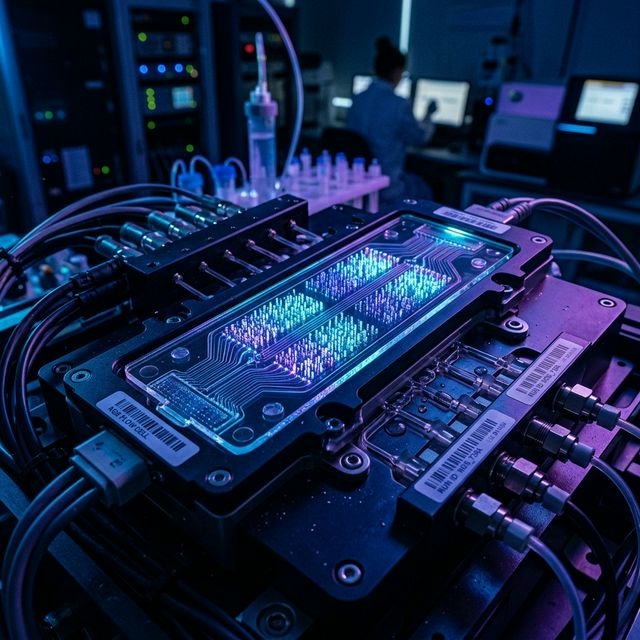
Next-Generation Sequencing (NGS) flow cell verification.
How to Read Core QC Metrics
Use these rows as a fast interpretation layer when you open a vendor QC sheet or NGS readout. They are meant to help you triage what looks strong, borderline, or worth escalating, not to replace application-specific thresholds.
| Metric | What It Measures | Formula | What Strong Looks Like | Borderline Review | Escalate When |
|---|---|---|---|---|---|
| Representation | % of designed oligos detected | Detected / Designed × 100 | Most designed oligos are still present | Noticeable attrition but the pool is still broadly recoverable | Dropout clusters or the application-specific floor is missed |
| Dropout Rate | % of oligos completely absent | (Designed - Detected) / Designed | Missing sequences stay rare and scattered | Loss is visible but not yet dominant | Whole sequence classes disappear or library bottlenecks become obvious |
| Uniformity (CV) | Read count variation | StdDev / Mean of reads | Read-count spread stays relatively tight | A long tail is forming but does not dominate the pool | Severe outliers or a broad tail are likely to distort downstream use |
| Gini Coefficient | Distribution inequality | Lorenz curve calculation | Counts are fairly even across the pool | Meaningful skew is emerging in the read distribution | A small subset of oligos is dominating the library |
| Error Rate | Per-base synthesis accuracy | 1 - (Perfect reads / Total) | Full-length reads still support the intended assay | Errors may be workable only with filtering or clone screening | Sequence burden is high enough to undermine the planned use case |
| Fold-Range | Max/min read count spread | Max reads / Min reads | No extreme max/min outliers are visible | Outliers exist but do not yet define the pool | A few sequences swamp the library while others are barely detectable |
How QC Priorities Change by Application
The same pooled readout should not be judged with one universal cutoff. This table shows which QC gate usually matters first in each application. For published threshold bands and source trails, open the QC thresholds by application research page.
| Application | Primary QC Gate | Why It Dominates | When to Escalate into Evidence |
|---|---|---|---|
| CRISPR KO Screen | Coverage and representation through selection | Abundance loss can look like biology when coverage is too thin | When you need published pooled-screen coverage floors |
| CRISPRa/i Screen | Coverage plus uniformity across subtle phenotypes | Small effect sizes make bottlenecks harder to spot from summary averages alone | When the screen design needs stronger published coverage guidance |
| NGS Capture Panel | Panel balance and on-target performance | Uniform presence matters more than one generic pooled-library cutoff | When assay validation needs to be separated from generic pool QC |
| DMS / Mutagenesis | Variant or barcode read depth plus uniformity | Under-sampled variants distort enrichment scores and frequency calls | When you need published DMS or mutagenesis depth bands |
| Gene Assembly | Post-correction error burden | Sequence accuracy dominates rework cost once constructs get longer | When the pool is being evaluated for synthesis-error burden rather than screening balance |
| MPRA | Barcode complexity with matched DNA and RNA coverage | Barcode loss destabilizes activity estimates even when total reads still look high | When you need published barcode-support filters and QC interpretation notes |
How to Calculate These Metrics
Sequence Your Pool
Perform NGS at required depth. Map reads to designed sequences with bowtie2 or BWA. Count reads per oligo.
Calculate Representation
Count oligos with ≥1 read. Divide by total designed oligos. Flag missing sequences for redesign.
Calculate Uniformity
Compute CV (StdDev/Mean), Gini coefficient, and fold-range from read count distribution.
Use Uniformity Estimator →Assess Error Rate
Align reads to designed sequences. Calculate per-base mismatch, insertion, and deletion rates.
Use Error Rate Calculator →Frequently Asked Questions
What is the Gini coefficient for oligo pools?▾
What NGS depth do I need to verify my pool?▾
How do I calculate oligo pool uniformity?▾
What error rate is acceptable for oligo pools?▾
Related QC Metric Pages
Understand Synthesis Methods
Compare array and column synthesis when QC expectations differ.
Prevent QC Failures with Design Rules
Review sequence rules that reduce dropout and synthesis bias.
Fix Oligo Pool QC Problems
Review common pool quality issues and how to troubleshoot them.
Estimate Uniformity Before Ordering
Model pool-uniformity risk before a vendor report exists.
Run Batch Sequence QC
Screen the full sequence set for GC, Tm, homopolymer, length, and structure risks before ordering.
Predict Synthesis Error Rate
Estimate accuracy and full-length yield before submission.
Open QC Thresholds by Application
Check the literature-backed threshold bands behind CRISPR, DMS, MPRA, and gene-assembly QC decisions.
Compare Vendor QC Packages
See how vendors differ on QC depth, included validation, and fit.