Which Oligo Pool Vendor to Choose? Twist, IDT, Agilent, GenScript
Use this page after the main oligo pool guide to turn current public vendor disclosures into a working shortlist. It compares the four major oligo pool vendors side by side for publicly disclosed oligo length, capacity, turnaround, QC wording, and service boundaries. If you need the underlying public vendor details behind those calls, open the public vendor specifications.
Compares vendor fit after pool requirements, QC expectations, and file format are clear.
Short-listing vendors by public specs, turnaround, QC wording, and service boundaries before vendor confirmation.
Public vendor materials re-checked on April 22, 2026. Re-check before ordering.
Review the public vendor specifications before requesting quotes, then confirm length limits, pool size, QC scope, and delivery format with the vendor.
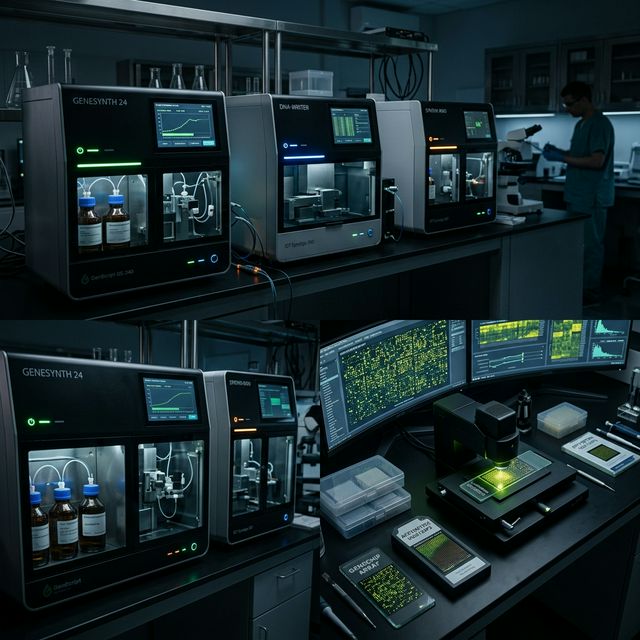
Contrasting commercial synthesis platform capabilities.
Head-to-Head Comparison
| Specification | Twist Bioscience | Agilent SurePrint | IDT oPools | GenScript GenTitan |
|---|---|---|---|---|
| Published oligo length | Up to 350 nt | Public store SKUs show standard and HiFi tiers through 111-170 nt and 211-230 nt, with official Agilent tables covering the 30-230 nt range. | 40-350 bases | 20-170 nt |
| Published pool or chip capacity | Public page says there are no stated limits on pool size. | Public store examples show capacities up to 244,000 unique sequences on a chip. | Public page lists scale tiers covering 100-20,000 oligos depending on pmol-per-oligo tier. | Public services specification lists HIFI 92K and HD 8M chip tiers, with up to 8 million oligos on one chip. |
| Published turnaround | 2-4 business days for standard Oligo Pools up to 350 nt; cloned pools are published with baseline windows of 4-6 or 6-8 weeks depending on length. | Standard SurePrint Oligo Pools are listed at as few as 3 business days with 90% complete within 6 business days; HiFi pools are listed at as few as 5 business days with 90% complete within 8 business days. | 4-7 business days | 3-5 business days |
| Public QC wording | Public specs publish uniformity >90% within <2.0x of mean and error rate up to 1:3000 for standard pools. The cloned-pool page publishes chimera rate as low as 1.5%. | Public overview and HiFi pages both state stringent process monitoring and multi-faceted QC, and HiFi publishes error rates as low as 1 in 4000 nucleotides. | The public page says QC and quantification are none, while the supporting product data highlights low-dropout and improved coupling-efficiency claims. | Public services specification lists visual verification per electrode, full-spectrum purity and yield analysis, guaranteed final yield, and spike-in full-length verification. PCR amplification, cloning, and sequencing for coverage and accuracy are extra-fee options. |
| Public process or format note | Silicon-based DNA writing technology with standard ssDNA pools plus a separate cloned-pool service. | SurePrint pooled synthesis uses microfluidic DNA writing technology, with a separate HiFi tier for higher-fidelity projects. | Pooled DNA oligos delivered dry in a 2 mL tube; mixed bases plus 5′ phosphorylation are listed on the public spec table. | GenTitan uses high-density CMOS and Miniature Semiconductor Chip (MSC) DNA synthesis technology with HIFI 92K and HD 8M service tiers. |
| Ordering caveat | Cloned Oligo Pools are a separate offering capped at 300 nt, and turnaround extends further if new vector onboarding is required. | Public specs are spread across overview, HiFi, and store SKU pages, so the exact tier still needs vendor confirmation. | Review whether your application needs a separate QC package because the product page does not position oPools as quantified material. | The public page separates HIFI 92K and HD 8M tiers, and deeper coverage or sequence-accuracy checks are positioned as add-on services. |
Verified against current public vendor websites on April 22, 2026. This table now tracks only documented public specifications, not unpublished pricing, custom quote terms, or inferred application performance.
How to Short-List by Requirement
These shortlist calls are based on what the vendors publicly disclose, not unpublished pricing, quote-only service promises, or platform performance that the public pages do not document.
Need the longest publicly disclosed oligo range
Both current public pages reach 350 nt on standard pool offers. Use IDT when its mixed-base and 5′ phosphorylation disclosures matter, and use Twist when its standard-pool turnaround wording better matches the project.
Plan a gene-assembly pool →Need the clearest public QC language
Twist publishes numeric uniformity and error-rate wording on the standard pool page, while Agilent HiFi publishes both multi-faceted QC language and an error-rate claim as low as 1 in 4000 nucleotides.
Review Oligo Pool QC metrics →Need the highest publicly disclosed chip density
GenScript publicly separates HIFI 92K and HD 8M service tiers and explicitly claims up to 8 million oligos on one chip. That makes it the clearest public-density option in this set.
Plan a screening pool →Need vendor-side cloning as part of the public offer
Twist is the only vendor in this comparison with a clearly published cloned-pool service page, including its own length cap, chimera-rate language, and baseline turnaround windows.
Move into synthesis planning →Frequently Asked Questions
Which vendor is cheapest for oligo pools?▾
Which vendor publishes the clearest QC details?▾
Do any vendors offer cloning-ready oligo pools?▾
What is the maximum oligo length each vendor supports?▾
Related Vendor Evaluation Pages
Open the Oligo Pool Guide
Return to the overall design, synthesis, QC, and applications map.
Estimate Oligo Pool Cost Before Requesting Quotes
Calculate pool cost by application and vendor fit.
Design an Oligo Pool Before Ordering
Use a five-step checklist before you send sequences out.
Open Ordering Checklist
Check file formats, naming rules, and submission requirements.
Read Oligo Pool QC Metrics
Interpret uniformity, dropout, error rate, and incoming QC expectations.
Choose Between Array and Column Synthesis
Compare array and column synthesis trade-offs.
Open Public Vendor Specifications
Check the public source details behind length, capacity, turnaround, and QC claims.