CRISPR sgRNA Design Guide - Spacer Rules, GC & QC
Use this page when you need to design a CRISPR sgRNA library and make sure it is ready for cloning, packaging, and screening. It walks through choosing the right library format, ranking guides, sizing the pool, defining the oligo, and checking both pre-order and post-synthesis QC. If you need a faster answer on one step, open the CRISPR library guide, Coverage Calculator, Batch Sequence QC, and Oligo Pool QC Metrics. This guide covers sgRNA design rules, spacer GC balance, off-target filters, and controls; the use-case checklist covers pre-order coverage, quote fields, and vendor-ready file preparation.
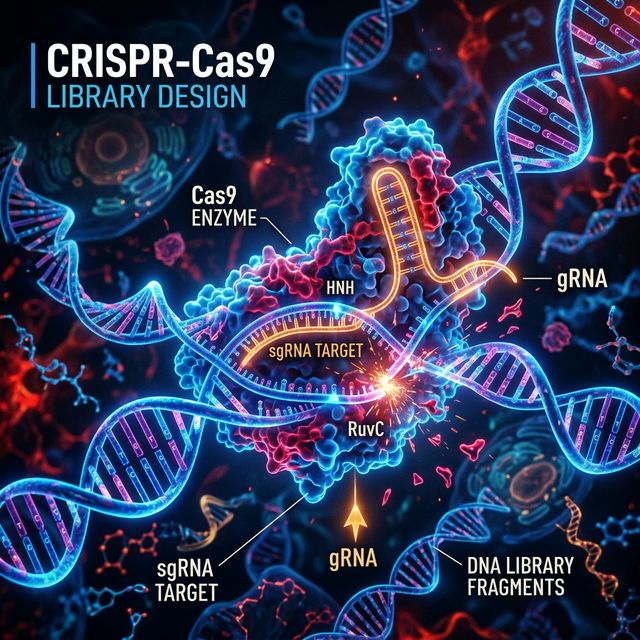
Choose guides, size the library, and set QC thresholds before cloning and screening.
Key Takeaways
- Use 4-10 sgRNAs per gene for knockout screens — more guides increase statistical power and reduce false negatives.
- Select sgRNAs with GC content 40-70%, avoid TTTT (polymerase III terminator), and target constitutive exons in the first 50% of the coding sequence.
- Activity scoring (Rule Set 2/Azimuth) and off-target analysis (CFD score >0.9, MIT score >80) are both essential for guide selection.
- Pool synthesis oligos are typically 73-80 nt for SpCas9: 20 nt spacer + scaffold overlap + amplification primers + restriction sites.
- Verify library representation by NGS at 500-1000x coverage: >90% of guides detected, Gini <0.25, <10% dropout.
- Include 500-1000 non-targeting control guides plus 50-100 essential gene positive controls in every library.
What are you trying to decide?
Page contents
Which CRISPR Library Format Fits Your Screen?
Start by matching the library format to the screen objective. Knockout, CRISPRa, CRISPRi, base editing, and tiling libraries need different target regions, guide counts, and downstream QC expectations.
| Library Type | Cas Protein | Target Region | Guides/Gene | Typical Library Size |
|---|---|---|---|---|
| CRISPRko (Knockout) | SpCas9 (active) | Constitutive coding exons | 4-6 | ~80K-120K guides |
| CRISPRa (Activation) | dCas9-VP64/p65/Rta | Promoter (-200 to +1 of TSS) | 5-10 | ~100K-200K guides |
| CRISPRi (Interference) | dCas9-KRAB | TSS region (-50 to +300) | 5-10 | ~100K-200K guides |
| Base Editing | CBE4 or ABE8e | Coding exons (edit window pos 4-8) | 4-8 | ~80K-160K guides |
| Tiling | SpCas9 or dCas9 | Every PAM across target region | All possible | 50-500 per region |
Which Cas system fits your delivery and PAM constraints?
| System | PAM | Spacer Length | Cut Type | Advantages |
|---|---|---|---|---|
| SpCas9 | NGG | 20 nt | Blunt (3 bp upstream PAM) | Most validated, best scoring tools |
| SaCas9 | NNGRRT | 21-23 nt | Blunt | Smaller size for AAV delivery |
| AsCas12a | TTTV | 23 nt | Staggered (5' overhang) | AT-rich targets, multiplex from single transcript |
| LbCas12a | TTTV | 23 nt | Staggered (5' overhang) | High activity at 37°C |
| enAsCas12a | TTYN, VTTV, TRTV | 23 nt | Staggered | Expanded PAM flexibility |
How Should You Filter and Rank sgRNAs?
Treat sgRNA selection as a ranking process, not a single score cutoff. Start with hard filters, then compare on-target and off-target scores so you know why each guide made the final library.
| Criterion | Optimal | Filter (Hard) | Rationale |
|---|---|---|---|
| GC Content | 40-70% | Exclude <30% or >80% | Binding stability and activity correlation |
| Poly-T | No TTTT | Exclude any TTTT | Pol III termination signal |
| Homopolymer | ≤3 consecutive | Exclude ≥5 consecutive | Synthesis error and misalignment |
| Target Position | First 50% of CDS | Exclude last 10% of CDS | Earlier frameshifts = stronger KO |
| Exon Targeting | Constitutive exons | Avoid alt-spliced exons | Ensure disruption in all isoforms |
| Activity Score | Rule Set 2 >0.6 | Exclude <0.2 | Predicts cutting efficiency |
| Specificity (CFD) | CFD >0.9 | Exclude <0.5 | Off-target risk assessment |
| Specificity (MIT) | MIT >80 | Exclude <50 | Alternative specificity metric |
Which scoring models should you trust?
Rule Set 2 / Azimuth (Doench et al., 2016): Gradient-boosted regression tree model trained on >4,000 sgRNAs targeting 17 genes across multiple cell lines. Azimuth is the software implementation of Rule Set 2. Input features include dinucleotide composition, GC content, position-specific base preferences, and chromatin accessibility. Scores range from 0-1, with >0.5 indicating high predicted activity. Significantly outperforms Rule Set 1 (Doench et al., 2014, which used logistic regression on ~1,800 sgRNAs). Available through the Broad GPP portal.
CFD Score (Doench et al., 2016): Cutting Frequency Determination score for off-target prediction. Trained on the same dataset as Rule Set 2. Evaluates each mismatch position and type independently. Higher CFD = higher off-target risk at that site.
DeepCas9 / CHOPCHOP: Deep learning models trained on larger datasets. Consider these for non-standard applications or when designing guides for organisms with limited training data coverage.
Screen your designed spacer sequences with our GC Content Analyzer (batch mode) and Batch Sequence QC to identify sequences with extreme GC, TTTT motifs, or problematic homopolymers before synthesis.
How Large Will the Library and Screen Be?
Before you order the pool, confirm that library size, cell coverage, and sequencing depth all still fit the experiment. Underpowered CRISPR screens hide real hits and inflate guide-level noise.
| Screen Type | Guides/Gene | Total Library Size | Cell Coverage | Cells Needed |
|---|---|---|---|---|
| Genome-wide KO | 4 | ~80K | 500x per guide | 40M cells |
| Genome-wide CRISPRa/i | 5-10 | ~100-200K | 500x per guide | 50-100M cells |
| Focused sublibrary | 6-10 | 1K-10K | 1000x per guide | 1-10M cells |
| Tiling screen | All available | 5K-50K | 500x per guide | 2.5-25M cells |
Use our Coverage Calculator to determine the minimum cell number, sequencing depth, and replicate count for your screen design. The tool accounts for library complexity, infection efficiency (MOI), and desired statistical power.
What Should Each CRISPR Library Oligo Contain?
Every CRISPR library oligo needs to carry the spacer plus the constant regions required for amplification, cloning, and expression. Lock this architecture before vendor confirmation so length limits and downstream cloning stay aligned.
Typical SpCas9 Library Oligo (lentiGuide-Puro)
| Element | Length | Function |
|---|---|---|
| Forward primer | 18-22 nt | PCR amplification handle |
| BsmBI site + overhang | 10 nt | Golden Gate cloning into vector |
| Spacer sequence | 20 nt | sgRNA targeting sequence (variable) |
| BsmBI site + overhang | 10 nt | Golden Gate cloning into vector |
| Reverse primer | 18-22 nt | PCR amplification handle |
| Total oligo | 76-84 nt | Well within array synthesis limits |
Verify your full oligo sequences (spacer + constant regions) through our Batch Sequence QC tool before ordering synthesis. This checks for unintended restriction sites that would interfere with cloning, as well as secondary structures that could impair PCR amplification of the pool.
Which Sequence Checks Should You Run Before Ordering?
Run full-length sequence checks before you approve synthesis. This is where you catch TTTT terminators, GC extremes, structures, and Tm outliers before they become dropout or amplification bias.
TTTT Motif Check
The most critical filter: any spacer containing TTTT will produce a truncated, non-functional sgRNA. This is a hard filter — no exceptions.
Use Batch QCGC Content Analysis
Spacer GC 40-70%. Extreme GC causes synthesis bias (dropout) and reduced Cas9 activity. Use batch mode for genome-wide libraries.
Use GC AnalyzerSecondary Structures
Strong hairpins in the spacer (ΔG < -3 kcal/mol) can block Cas9 loading. Check the full oligo for structures that impair PCR amplification.
Use Structure PredictorTm Uniformity
For PCR amplification handles, ensure consistent Tm (58-62°C). The spacer region contributes to overall oligo Tm — check for outliers.
Use Tm CalculatorHow Do You QC the Library After Synthesis and Cloning?
After synthesis and cloning, review the library as a release decision. You need to know whether representation, uniformity, titer, MOI, and replicate behavior are strong enough to screen or whether you should re-clone, scale up, or re-order.
| QC Stage | Metric | Target | If Failed |
|---|---|---|---|
| Plasmid Library | Representation (NGS) | >90% guides detected | Sub-clone at higher ratio |
| Plasmid Library | Uniformity (Gini) | <0.25 | Re-amplify with fewer cycles |
| Plasmid Library | Dropout rate | <10% | Redesign/resynthesize dropped guides |
| Viral Production | Titer (TU/mL) | >10^7 for lenti | Concentrate by ultracentrifugation |
| Transduction | MOI | 0.3-0.5 (30-50% infection) | Titrate virus on target cells |
| Screen Coverage | Cells per guide | ≥500x | Scale up cell culture |
| Screen Results | Replicate correlation | Pearson r >0.7 | Add technical replicates |
Use our Uniformity Estimator to predict expected representation from your sequencing depth, and our Coverage Calculator to determine minimum sequencing depth for adequate power.
Planning a 500-Gene Kinase Screen
This example shows how a focused CRISPR knockout project turns guide selection, controls, oligo design, and screen coverage into an actual order plan for a first pooled screen.
Define Your Gene List
Start with the KinBase curated human kinome (518 protein kinases). For a drug resistance screen, also add 20-30 known resistance genes from literature (drug efflux pumps, target pathway genes). Final list: ~545 genes.
Design sgRNAs with CRISPick
Upload your gene list to CRISPick (Broad GPP). Settings: SpCas9, Human GRCh38, CRISPRko mode, 6 guides per gene. CRISPick applies Rule Set 2 scoring and CFD off-target analysis automatically.
Add Constant Regions
Append amplification primers and BsmBI cloning sites. Each oligo: 5'-CACCG(20nt spacer)GTTTTAGAGCTAGAAATAGC-3' = 45 nt. With PCR handles: ~85 nt total. Run all 4,000 through Batch QC — expect ~98% pass rate.
Order and Screen
Order from Twist (4K pool at ~85 nt = ~$320). Amplify with 8 PCR cycles, clone into lentiGuide-Puro. Cells needed: 4,000 guides × 500x coverage = 2M cells per replicate (very manageable). Total timeline: 8-10 weeks from gene list to screen results.
Design note: A focused 4K library is an ideal first CRISPR screen — it requires only 2M cells per replicate (one T75 flask), costs ~$500 total for synthesis + cloning, and can be sequenced on a single MiSeq run. Start here before attempting genome-wide screens that need 100M+ cells.
QC check: Don't skip pre-synthesis QC even for small libraries. In our kinase example, ~80 of 3,270 sgRNAs (2.4%) contain poly-G runs or extreme GC content. These will drop out of the pool, creating blind spots in exactly the genes you care about. Replace them with alternative sgRNAs from CRISPick.
Which sgRNA Design Tool Fits Your Project?
Several free tools can design sgRNA libraries, but they are not interchangeable. Choose based on library scale, organism, editing mode, and whether you need pooled-screen throughput or gene-by-gene flexibility.
| Tool | Scoring | Off-Target | Batch Size | Best For | Limitation |
|---|---|---|---|---|---|
| CRISPick (Broad) | Rule Set 2 / Azimuth | CFD + MIT | Genome-wide | Large-scale KO/CRISPRa/i screens | Human/mouse only |
| CHOPCHOP | Multiple (configurable) | Bowtie alignment | 1-50 genes | Multi-organism, individual genes | Not suited for genome-wide |
| CRISPRscan | Moreno-Mateos 2015 | Basic alignment | 1-10 genes | Zebrafish, in vivo injection | Trained on zebrafish data |
| BE-Designer | BE-Hive / ABE prediction | Cas-OFFinder | 1-100 genes | Base editing screens | BE-specific, not for KO |
| GUIDES (Zhang lab) | Combined activity score | Comprehensive | 1-1000 genes | Custom focused libraries | Slower for large batches |
Tool selection note: Use CRISPick for any library with >50 genes — it has the best-validated scoring algorithm and handles genome-wide designs. For smaller projects or non-model organisms, use CHOPCHOP for its flexibility. For base editing libraries, BE-Designer is essential as it predicts the editing window and outcome. Regardless of tool, always post-process with our Batch QC to catch synthesis-problematic sequences.
How Long Will the Project Take and What Will It Cost?
Budget the full project, not just the oligo pool. Cloning, cell culture, virus production, sequencing, and analysis often cost more than synthesis itself.
| Phase | Duration | Cost (Focused 4K) | Cost (Genome-wide 80K) | Key Deliverable |
|---|---|---|---|---|
| 1. sgRNA Design | 2-3 days | $0 (free tools) | $0 (free tools) | Ranked sgRNA list + QC report |
| 2. Oligo Synthesis | 2-3 weeks | $200-400 | $3,000-6,000 | Lyophilized oligo pool |
| 3. Cloning + QC | 1-2 weeks | $200-500 | $500-1,500 | Plasmid library (NGS-verified) |
| 4. Virus Production | 1 week | $100-200 | $300-600 | Lentiviral stock (titered) |
| 5. Screen Execution | 2-4 weeks | $500-1,500 | $2,000-5,000 | Selected cell populations |
| 6. NGS + Analysis | 1 week | $300-500 | $800-1,500 | Hit gene list |
| Total | 8-12 weeks | $1,300-3,100 | $6,600-14,600 | Validated hit list |
Budget note: The biggest variable cost is cell culture, not synthesis. For adherent cells, genome-wide screens require 50-100 T175 flasks per replicate. Use suspension cells if possible (e.g., K562, Jurkat) — they scale easily in spinner flasks and need less hands-on time.
Cloning check: Don't underestimate the cloning step. Golden Gate cloning of oligo pools has a typical 40-60% correct insertion rate. You need enough colonies/transformations to achieve >90% library representation. Plan for at least 10-20× the library size in colonies (e.g., 40K-80K colonies for a 4K library). Electro-competent cells with >10⁹ CFU/μg efficiency are essential.
Protocol: Golden Gate Cloning of Oligo Pool into lentiGuide-Puro▾
Use electro-competent cells with >10⁹ CFU/μg efficiency (Endura or MegaX DH10B). Chemical transformation is insufficient for large libraries. Expect 40-60% correct insertions; the remainder are empty vector or recombinants. Source: Addgene CRISPR Pooled Library Cloning Protocol; Joung et al., Nature Protocols 2017.
Which Controls Should You Include in the Library?
Controls determine whether the final screen is interpretable. Include enough negative, positive, and cut-site controls to separate biology from technical noise.
| Control Type | Count | Purpose | Source | Priority |
|---|---|---|---|---|
| Non-targeting | 500-1000 | Null distribution for statistics | Random 20mers, no genomic match | Essential |
| Safe-harbor targeting | 100-200 | Cut-site effect control | AAVS1, ROSA26 intergenic guides | Recommended |
| Essential gene (+ctrl) | 50-100 | Validate KO efficiency | CEG2 set (Hart et al., 2017) | Essential |
| Known drug targets | 20-50 | Validate screen phenotype | Literature-curated for your drug | Recommended |
| GFP/RFP targeting | 10-20 | Measure infection & KO efficiency | Target reporter in Cas9 cells | Optional |
Representation check: Use your non-targeting controls to calculate representation uniformity. Since they have no biological effect, their read count distribution should reflect pure technical noise. If non-targeting controls show >5-fold variation, your screen has a systematic bias (infection MOI, cell growth artifacts) and results should be interpreted cautiously. This is the single best internal quality metric for any CRISPR screen.
How Should You Package Virus and Set MOI?
Lentiviral packaging is where many otherwise solid libraries fall apart. Set MOI and cell coverage early so packaging, infection, and selection stay compatible with the screen design.
| Parameter | Optimal | Acceptable | Problematic |
|---|---|---|---|
| MOI (pooled KO screen) | 0.3–0.5 | 0.5–0.7 | >0.7 (multi-infection) |
| MOI (CRISPRi/a screen) | 0.3–0.5 | 0.5–1.0 | >1.0 |
| Transduction efficiency | 30–50% | 20–30% | <20% (insufficient) |
| Viral titer (TU/mL) | 10⁷–10⁸ | 10⁶–10⁷ | <10⁶ (re-package) |
| Cell coverage per guide | ≥500 cells | 200–500 cells | <200 cells |
| Selection antibiotic | Puromycin 2 μg/mL, 48h | Puro 1–3 μg/mL, 48–72h | No selection (noise) |
Cell-count calculation: To calculate the number of cells needed for infection: Cells = (Library size × coverage) / MOI. For a 4K library with 500× coverage at MOI 0.3: 4,000 × 500 / 0.3 = 6.7 million cells needed. For a genome-wide 80K library: 80,000 × 500 / 0.3 = 133 million cells — plan for T175 flasks or spinners!
MOI check: Never skip the MOI titration. Infect small aliquots at serial dilutions (1:10, 1:30, 1:100, 1:300) and measure survival after puromycin selection. Aim for ~30% survival = MOI 0.3. If you inherit virus from another lab, always re-titer — freeze-thaw cycles degrade lentivirus by 10–50% per cycle.
Frequently Asked Questions
How many sgRNAs per gene do I need for a CRISPR screen?▾
What is the difference between CRISPRko, CRISPRa, and CRISPRi libraries?▾
Why should I avoid TTTT sequences in sgRNAs?▾
What Cas systems can I use for CRISPR screens?▾
How do I analyze CRISPR screen results?▾
What controls should I include in my CRISPR library?▾
Related Tools
Coverage Calculator
Determine required library size, cell coverage, and sequencing depth for CRISPR screens.
GC Content Analyzer
Batch GC analysis for sgRNA spacer sequences. Filter guides outside 40-70% range.
Batch Sequence QC
Screen library oligos for TTTT motifs, homopolymers, and synthesis-problematic sequences.
Secondary Structure Predictor
Check spacer sequences for hairpins that block Cas9 loading.
Uniformity Estimator
Predict library representation uniformity from pool size and sequencing depth.
Error Rate Calculator
Estimate synthesis error rates and full-length oligo percentage for your library.
Related CRISPR Library Pages
Continue with the pool-ordering, QC, or CRISPR guide that matches the next job after library design.
Plan Oligo Pool Synthesis from Design to QC
Open synthesis planning when platform choice, quote strategy, and delivery planning come next.
What QC Should I Request for Oligos?
Use this when the next decision is vendor QC expectations, purification, or acceptance criteria.
Open the CRISPR Library Guide
Switch to the execution guide when you already know the core library architecture.
Open the Pool QC Walkthrough
Move here if the guide set is stable and the next job is a hands-on pre-order QC pass.
Design and Validate PCR Primers
Useful when your CRISPR project also includes primer or amplicon checks around library validation.