
Which QC Checks Matter Before Ordering an Oligo Pool?
Quality control for oligonucleotide pools validates sequences before synthesis to prevent experimental failures. Pool QC differs from single-oligo validation by requiring uniform properties across hundreds to thousands of sequences while ensuring synthesis compatibility and experimental reproducibility.
- Individual sequence quality: Each sequence passes thermodynamic and compositional thresholds
- Pool uniformity: GC content SD <2%, Tm range <10°C, length variation <20%
- Synthesis compatibility: No homopolymers >4bp, secondary structures ΔG >-3 kcal/mol
- Multiplex compatibility: Sequences avoid cross-hybridization (analyzed with Primer Analyzer)
Pre-Order Oligo Pool QC
QC Overview: Input sequences → Batch validation → Pass/Fail decision → Export or redesign → Iterate until >95% pass rate
Common Pre-Order QC Metrics
GC Content Analysis (use GC Content Analyzer)
- Acceptable range: 40-60% (individual sequences)
- Pool uniformity: Mean 45-55%, standard deviation <2%
- Critical flags: <30% or >70% (synthesis failure risk >50%)
- NGS libraries: Maintain ±2% GC for uniform PCR amplification
Melting Temperature Validation (use Tm Calculator)
- Calculation method: Nearest-neighbor thermodynamics (SantaLucia & Hicks 2004, Annu. Rev. Biophys. Biomol. Struct.)
- PCR primers: 55-65°C (±3°C within pool)
- qPCR/hybridization: 60-70°C (±2°C for multiplex)
- Pool uniformity: <10°C range, <3°C SD optimal
- Salt conditions: Validate at experimental [Na+] (typically 50mM), use Owczarzy 2008 salt correction for accuracy
Homopolymer Detection
- Critical threshold: No runs >4bp (synthesis error rate increases 5-10x)
- Poly-A/T runs: Flag >3bp (array synthesis slippage)
- Poly-G runs: Flag >3bp (secondary structure formation)
- Cost impact: Homopolymer failures waste $200-500 per 96-well plate
Secondary Structure Analysis (use Secondary Structure Predictor)
- Hairpin threshold: ΔG >-3 kcal/mol (stable structures inhibit synthesis)
- Self-dimer threshold: ΔG >-5 kcal/mol (critical for PCR)
- Stem-loop structures: Flag stems >4bp with loops <3nt
- Analysis conditions: Validate at synthesis temperature (37°C) and experimental temperature
Sequence Complexity & Composition
- Low complexity: Flag dinucleotide repeats (AT/TA, GC/CG) >6bp
- Base balance: Each base 15-40% of total sequence
- 3' end stability: Last 5bp should have balanced GC (40-60%)
- Forbidden motifs: Check for restriction sites, adapter sequences
Pool Uniformity Metrics (use Pool Uniformity Estimator)

- Gini Coefficient: Target <0.15 for high uniformity in array synthesis. A Gini coefficient >0.25 indicates heavy pooling bias.
- Coefficient of variation (CV): <15% for GC content, Tm, length
- Outlier threshold: Flag sequences >2 SD from mean
- Synthesis yield prediction: Uniform pools: 80-95% yield; non-uniform: 30-60%
- NGS coverage uniformity: CV <20% ensures <3-fold representation bias
Quick Reference: Application-Specific QC Thresholds
Starting ranges to adapt for the synthesis provider and application
| Parameter | PCR Primers | qPCR Probes | CRISPR sgRNA | NGS Adapters | Oligo Pools |
|---|---|---|---|---|---|
| GC Content | 40-60% Optimal: 50% | 40-60% Strict ±5% | 40-60% Optimal: 50-55% | 45-55% Balanced required | 45-55% mean SD <2% |
| Tm Range | 55-65°C Pool: ±3°C | 60-70°C Pool: ±2°C | N/A Not critical | Matched Pool: ±2°C | Application-dep. Range <10°C |
| Length | 18-25 bp 20-22 bp ideal | 18-30 bp Probe-specific | 19-21 bp 20 bp standard | 18-25 bp Fixed per design | 40-200 bp CV <10% |
| Homopolymers | <4 bp No poly-G >3 | <4 bp Strict | <4 bp No poly-T >4 | <4 bp Critical | <4 bp Array: <4 strict |
| Secondary Structures | ΔG >-3 kcal/mol Hairpins critical | ΔG >-2 kcal/mol Very strict | ΔG >-3 kcal/mol Check carefully | ΔG >-4 kcal/mol Moderate | ΔG >-3 kcal/mol Pool average |
| 3' Stability | GC clamp (2-3bp) Required | No G at 5' end Quenching | Balanced Not critical | Balanced GC 40-60% | Variable Application-dep. |
| Critical QC Focus | Tm uniformity, dimers | Structures, Tm precision | Poly-T, off-targets | Edit distance, balance | Uniformity, outliers |
Note: Thresholds based on Illumina (2023), IDT (2026), Twist Bioscience (2026) technical specifications, and ISO 20395:2019 recommendations. Use Batch Sequence QC to validate against these thresholds.
How Do You Run Batch Sequence QC on a Large Sequence Set?
Prepare Your Sequences
Format sequences in FASTA format. Each sequence should have a header line starting with">" followed by an identifier, and one or more lines containing the nucleotide sequence.
ATCGATCGATCGATCGATCG
GCTAGCTAGCTAGCTAGCTA
ATATATATATATATATATAT
Ensure sequences contain only valid nucleotides (A, T, C, G for DNA; A, U, C, G for RNA). Remove any formatting characters, spaces, or ambiguous bases before QC.
Open the Batch QC Tool
Navigate to the Batch Sequence QC tool. This tool is specifically designed for comprehensive quality control of large sequence sets.
Input Sequences
You can input sequences in two ways:
- Paste sequences: Copy and paste FASTA-formatted sequences directly
- Upload file: Click"Upload File" and select a .txt or .fasta file
The tool supports up to 1,000 sequences free per batch, or 50,000 sequences per batch with Tool Membership.
Configure QC Thresholds
Set appropriate thresholds for your application:
Standard Thresholds (Most Applications):
- GC Content: 40-60% (flag <30% or >70%)
- Melting Temperature: 55-65°C (flag outside range)
- Length: 18-30 bp (flag outside range)
- Homopolymers: Flag runs of 4+ identical bases
- Secondary Structures: Flag hairpins (ΔG < -3 kcal/mol) and dimers (ΔG < -5 kcal/mol)
Application-Specific Adjustments:
- qPCR: Tighter Tm range (60-65°C), stricter secondary structure requirements
- CRISPR: Length 19-21 bp, check secondary structures carefully
- Oligo pools: Focus on uniformity, flag outliers
Run QC Analysis
Click"Run QC" to start analysis. The tool will:
- Validate sequence format and composition
- Calculate GC content for each sequence
- Calculate melting temperatures
- Check for homopolymers and repeats
- Predict secondary structures
- Flag sequences that fail any threshold
- Generate summary statistics
Processing time depends on pool size. Most batches process in 30-120 seconds.
Review Results
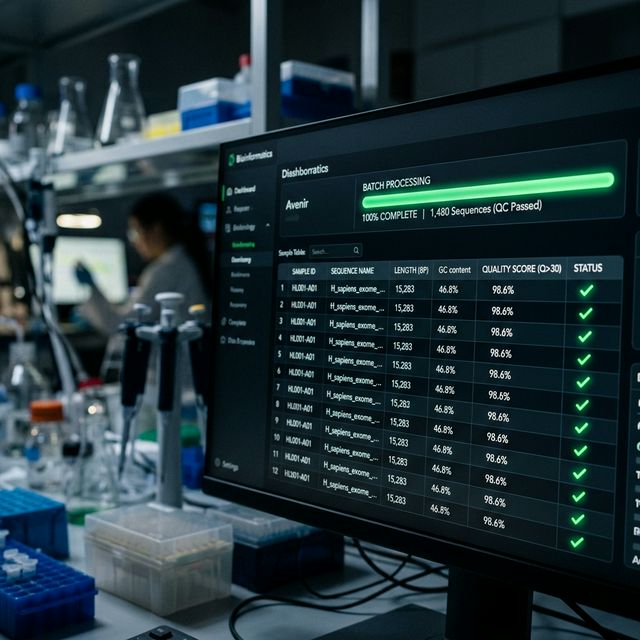
The results panel displays:
Summary Statistics:
- Total sequences analyzed
- Number of sequences passing all thresholds
- Number of sequences flagged (and reasons)
- GC content distribution (mean, median, range)
- Tm distribution (mean, median, range)
Flagged Sequences:
- List of sequences that failed thresholds
- Specific reasons for each flag (GC, Tm, homopolymer, structure, etc.)
- Severity indicators (warning vs. critical)
Pool Uniformity Metrics:
- GC content standard deviation (lower is better)
- Tm range (smaller is better for uniformity)
- Distribution histograms
Resolve Flagged Sequences
For each flagged sequence, decide:
- Accept: Minor issues may be acceptable for your application
- Redesign: Modify sequence to meet thresholds
- Exclude: Remove non-critical sequences
After fixing sequences, re-run QC to confirm all sequences pass thresholds.
Export Results
Export QC results as CSV for:
- Documentation and record-keeping
- Further analysis in Excel or R
- Integration with synthesis orders
- Tracking QC history
The CSV includes all sequence information, QC results, and flags for easy filtering and analysis.
What Does a Real QC Iteration Look Like on a CRISPR Library?

CRISPR Screening Library Example
Initial QC Review
- Total sequences:1,000
- Sequences passed:847 (84.7%)
- Sequences flagged:153 (15.3%)
- Failure breakdown:
- GC content issues:62 (6.2%)
- Homopolymer runs >4bp:51 (5.1%)
- Poly-T terminator (TTTT):28 (2.8%)
- Secondary structures:12 (1.2%)
Pool Uniformity Metrics
- Mean GC content:52.3%
- GC standard deviation:4.1% (target: <2%)
- Mean Tm:58.7°C
- Tm range:16.2°C (target: <10°C)
- Length (all sequences):20 bp
- Coefficient of variation:18.3% (target: <15%)
Remediation Actions Taken
- GC content optimization (62 sequences): Adjusted wobble positions in coding sequences, substituted AT-rich regions with GC bases where functionally acceptable. 58 sequences corrected, 4 excluded.
- Homopolymer disruption (51 sequences): Broke poly-A/T runs by inserting G/C at position +2 or +3 of runs. All 51 sequences successfully redesigned.
- Poly-T terminator removal (28 sequences): Critical for CRISPR - replaced T bases to avoid transcription termination. 27 sequences corrected, 1 target excluded (no viable alternative).
- Secondary structure disruption (12 sequences): Modified stem sequences to break complementarity, validated with Structure Predictor. All 12 corrected.
Revised QC Review
- Total sequences:995 (5 excluded)
- Sequences passed:967 (97.2%)
- Sequences flagged:28 (2.8%)
- Most high-severity flags resolved
Improved Uniformity
- GC standard deviation:1.8% (within target)
- Tm range:8.3°C (within target)
- Coefficient of variation:11.2% (within target)
- Pool-level metrics moved within the selected targets
Interpretation: The second review leaves a smaller set of low-severity flags and brings GC spread, Tm range, and coefficient of variation closer to the project targets. Treat these numbers as an illustrative review pattern, then confirm acceptance criteria with the synthesis provider and downstream assay requirements.
Which QC Habits Reduce Synthesis Failures and Rework?
Implement Iterative QC During Design
Run QC at design stage (not pre-synthesis only) to enable rapid iteration. For pools >1,000 sequences, QC in batches of 500-1,000 during generation. Early QC reduces redesign time from days to hours and identifies systematic design flaws (e.g., biased GC distribution, repetitive motifs).
- Design checkpoint QC: 25%, 50%, 75%, 100% completion
- Consistent validation: Use Batch Sequence QC with the same thresholds across design iterations
- Project planning: Early QC can reduce avoidable redesign, resynthesis, and schedule risk
Application-Specific Threshold Optimization
Start with platform-validated defaults, then optimize based on pilot data. Array synthesis (Agilent, Twist) requires stricter thresholds than column synthesis (IDT). NGS applications need tighter uniformity (GC SD <2%, Tm range <8°C) than PCR pools.
- Pilot synthesis: Test 96 sequences across parameter space before full pool
- Threshold refinement: Analyze synthesis yield vs. QC stringency to optimize cost/quality trade-off
- Platform consultation: Vendors provide application-specific QC guidelines (request from synthesis provider)
Prioritize Pool Uniformity Over Individual Perfection
For pools >100 sequences, uniformity metrics (CV, SD, range) predict experimental success better than individual sequence quality. Target: GC SD <2%, Tm range <10°C, length CV <10%. Exclude outliers >2 SD from mean even if individually"passing" to improve pool uniformity.
- Uniformity validation: Use Pool Uniformity Estimator for synthesis yield prediction
- Statistical QC: Calculate and track CV, SD, interquartile range for each parameter
- Outlier management: Remove sequences >2 SD from mean or modify to bring within 1.5 SD
Comprehensive Documentation for Reproducibility
Maintain QC documentation for troubleshooting, internal review, and method validation. Essential records: original sequences, QC parameters/thresholds, flagged sequences, modifications, re-QC results, final sequences, synthesis order details.
- Export formats: CSV from Batch QC, synthesis formats from Format Converter
- Version control: Track QC iterations (v1, v2, v3) with timestamps and modification rationale
- Quality-system review: For regulated work, confirm required records, signatures, and vendor documentation with your internal quality process
Integrated Multi-Tool QC Pass
Comprehensive QC requires multiple specialized tools. Recommended order:
- Batch Sequence QC - primary validation (all parameters)
- GC Content Analyzer - distribution analysis and outlier detection
- Tm Calculator - thermodynamic validation with experimental salt conditions
- Secondary Structure Predictor - detailed structure analysis for flagged sequences
- Pool Uniformity Estimator - synthesis yield and coverage prediction
- Error Rate Calculator - synthesis quality metrics and cost estimation
- Format Converter - clean FASTA, CSV, TSV, or plain sequence files before final vendor formatting
- Vendor Format Adapter - generate vendor-specific synthesis order columns after QC
See the full page on how to QC a large oligo pool before ordering with threshold guidance and troubleshooting notes.
QC Success Metrics
- Target pass rate: Define the acceptable flag rate before ordering and document any exceptions
- Pool uniformity: GC SD <2%, Tm range <8°C, CV <12%
- Synthesis yield: >80% sequences with >50% expected yield
- NGS coverage: Median CV <20%, no sequences <10% median coverage
- Experimental success: <5% PCR failure rate, <10% NGS dropout