PCR Primer Design Guide - Tm, GC, Dimers & Ordering Checks
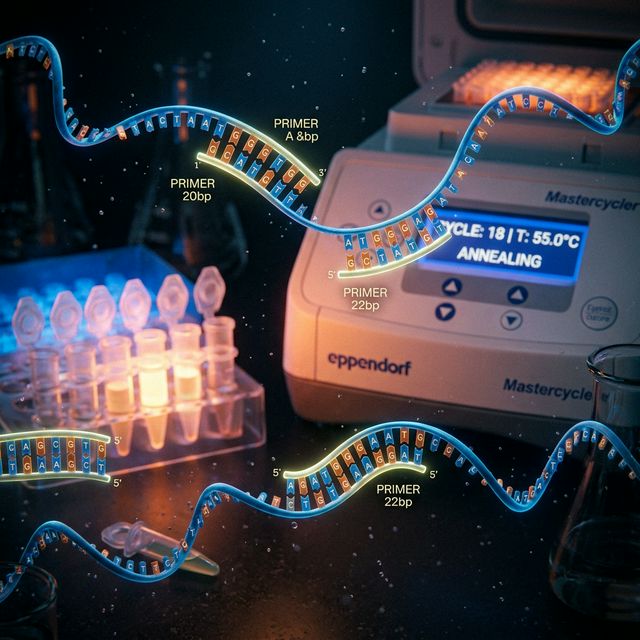
Primer design decisions show up later as specificity, yield, and failed-PCR noise.
Use this page when you need to design PCR primers and understand why a candidate pair should work before you order it. It walks through primer rules, Tm method choice, GC and structure thresholds, PCR-specific design differences, and failure diagnosis. If you already know the next action, open Validate PCR Primers Before Ordering, Tm Calculator, GC Content Analyzer, and Secondary Structure Predictor.
Key Takeaways
- •Optimal primer length is 18-25 nucleotides, with 20-22 nt providing the best balance of specificity and binding stability.
- •Target Tm range of 55-65°C (ideal 58-62°C) using the nearest-neighbor method — forward and reverse primers should differ by less than 5°C.
- •GC content between 40-60% ensures stable binding without excessive secondary structures. End the 3' terminus with 1-2 G/C bases (GC-clamp).
- •Screen all primers for hairpins (ΔG > -2 kcal/mol), self-dimers (ΔG > -5 kcal/mol), and hetero-dimers (ΔG > -5 kcal/mol) before ordering.
- •For standard Taq-style conditions, use 3-5°C below the lower primer Tm only as a starting point; follow enzyme-specific guidance and confirm with a gradient.
- •Always use the same salt conditions in your Tm calculator as in your actual PCR buffer (check vendor specifications).
What are you trying to solve?
Page contents
What Makes a PCR Primer Likely to Work?
Strong PCR starts with primer pairs that bind specifically, amplify efficiently, and still make sense under the real buffer and thermal conditions you plan to run. These are the parameters worth checking before you spend time troubleshooting a bad assay.
| Parameter | Optimal | Acceptable | Avoid | Why It Matters |
|---|---|---|---|---|
| Length | 20-22 nt | 18-25 nt | <15 or >30 nt | Specificity vs secondary structure risk |
| GC Content | 45-55% | 40-60% | <30% or >70% | Binding stability and Tm prediction accuracy |
| Melting Temp (Tm) | 58-62°C | 55-65°C | <50°C or >72°C | Annealing specificity and efficiency |
| Tm Difference (F vs R) | <2°C | <5°C | >5°C | Both primers must anneal at the same temperature |
| 3' End (GC-Clamp) | 1-2 G/C | 1-3 G/C | >3 consecutive G/C | Stable extension initiation without mispriming |
| Homopolymer Runs | None | ≤3 bases | ≥5 consecutive | Slippage errors during synthesis and amplification |
Primer Specificity and Length
Primer specificity is determined by how uniquely the sequence maps to the target genome. In the human genome (~3.2 billion base pairs), a random 16-mer would statistically match ~0.75 times, making 18-20 nt the minimum for unique binding. Every additional nucleotide increases specificity by a factor of 4, but also increases the probability of internal secondary structures.
The 3' end of the primer is critical for specificity because DNA polymerase extends from this position. A single mismatch at the 3' terminus can prevent extension entirely, while mismatches at positions -2 and -3 from the 3' end also significantly reduce efficiency. This is why BLAST or Primer-BLAST searches should focus on 3' end matches when evaluating off-target binding.
Use our Primer Analyzer to get a comprehensive quality report including length assessment, GC analysis, and Tm prediction in a single tool.
GC Content and Distribution
GC content directly affects duplex stability: G-C base pairs form three hydrogen bonds versus two for A-T pairs, contributing ~1.5 kcal/mol more stability per pair. The optimal range of 40-60% provides sufficient stability without the problems associated with extremes.
Beyond the overall percentage, the distribution of G and C bases matters. A primer with 50% GC but all G/C bases clustered at one end will have uneven binding stability. Ideally, G and C bases should be distributed throughout the primer sequence. Use our GC Content Analyzer to visualize the distribution across your primer sequence with sliding-window analysis.
Which Tm Method and Buffer Settings Should You Use?
Tm is only useful if the calculator matches your chemistry. The right method and salt settings determine whether your annealing temperature reflects the real reaction or sends you into a failed-PCR loop.
| Method | Formula | Interpretation | Best For |
|---|---|---|---|
| Wallace Rule | Tm = 2(A+T) + 4(G+C) | Composition-only estimate | Quick mental estimates only |
| %GC Method | Tm = 81.5 + 0.41(%GC) - 675/N | Adds GC and length context | Primers 14-20 nt at 1M NaCl |
| Nearest-Neighbor (NN) | ΔH°/(ΔS° + R·ln(Ct/4)) | Sequence-aware; condition-dependent | Sequence-aware screening with matched inputs |
The nearest-neighbor method (SantaLucia 1998) is commonly preferred because it accounts for dinucleotide stacking interactions — the stability of each base pair depends on its neighbors. Our Tm Calculator implements this method with Owczarzy (2008) salt corrections for both Na⁺ and Mg²⁺, giving sequence-context-aware estimates for PCR conditions when the input settings match the assay.
Salt Settings for Common PCR Buffers
| Polymerase | Vendor | Na⁺/K⁺ (mM) | Mg²⁺ (mM) | Calculator Setting |
|---|---|---|---|---|
| Standard Taq / OneTaq | NEB | 50 | 2.0 | Na⁺ = 50, Mg²⁺ = 2.0 |
| Q5 High-Fidelity | NEB | 50 | 2.0 | Na⁺ = 50, Mg²⁺ = 2.0 |
| Phusion HF | Thermo Fisher | ~0 | 1.5 | Na⁺ = 0, Mg²⁺ = 1.5 |
| KAPA HiFi HotStart | Roche | ~0 | 2.5 | Na⁺ = 0, Mg²⁺ = 2.5 |
Source: NEB, Thermo Fisher, and Roche product datasheets (2026). Always verify with your specific buffer lot.
How do you convert Tm into annealing temperature?
For gradient PCR optimization, test a range around the protocol-based starting point. The best Ta depends on the polymerase, buffer, additives, template, and primer pair, so this formula is not a universal setting.
Which Secondary Structures Should Force a Redesign?
Secondary structures compete with target binding and are one of the fastest ways to waste a good primer sequence. Screen hairpins, self-dimers, and hetero-dimers before ordering so you know which issues are acceptable and which ones will keep generating artifacts.
| Structure Type | Acceptable ΔG | Warning | Redesign Required | Impact |
|---|---|---|---|---|
| Hairpins | > -2 kcal/mol | -2 to -3 kcal/mol | < -3 kcal/mol | Blocks template binding |
| Self-dimers | > -5 kcal/mol | -5 to -6 kcal/mol | < -6 kcal/mol | Depletes available primer |
| 3' End dimers | > -5 kcal/mol | -5 to -7 kcal/mol | < -7 kcal/mol | Primer-dimer artifacts on gel |
| Hetero-dimers | > -5 kcal/mol | -5 to -8 kcal/mol | < -8 kcal/mol | Competes with target amplification |
Thresholds based on IDT OligoAnalyzer guidelines, NEB Tm Calculator documentation, and Primer3 default parameters.
Use our Secondary Structure Predictor to calculate ΔG values at your annealing temperature. The tool supports hairpin, self-dimer, and hetero-dimer analysis modes. For primer pairs, test both forward-reverse and reverse-forward orientations.
Which Primer Rules Change for qPCR, RT-PCR, and Colony PCR?
Primer rules shift with the assay. Use the matrix below to avoid reusing a standard PCR design in qPCR, RT-PCR, or colony PCR without re-checking the parts that matter most.
| Parameter | Standard PCR | qPCR (SYBR / Probe) | RT-PCR (cDNA) | Colony PCR |
|---|---|---|---|---|
| Primer Length | 18-25 nt | 18-22 nt | 18-25 nt | 18-25 nt |
| Target Tm | 55-65°C | 58-62°C (tighter) | 55-65°C | 52-60°C |
| ΔTm (Fwd vs Rev) | <5°C | <2°C | <5°C | <5°C |
| GC Content | 40-60% | 45-55% (stricter) | 40-60% | 40-60% |
| Amplicon Size | 100 bp - 5 kb | 70-200 bp | 150-500 bp (span exon junction) | 500 bp - 2 kb |
| Dimer Tolerance | Moderate | Zero — even weak dimers give SYBR signal | Moderate | High |
| Special Rule | None | Single melt curve peak required | Span exon-exon junction to avoid gDNA | Crude template — use hot-start enzyme |
| Template | Purified gDNA/plasmid | cDNA or gDNA, highly pure | cDNA from reverse transcription | Bacterial colony lysate |
RT-PCR note: For RT-PCR, always design at least one primer to span an exon-exon junction. This eliminates genomic DNA contamination without needing a separate DNase treatment step. Check your gene's exon structure in NCBI Gene or Ensembl before choosing primer binding sites. Use our Tm Calculator in batch mode to verify that all primers in a set have Tm values within 2°C.
Primer storage note: Store primers at −20°C in TE buffer (10 mM Tris, 0.1 mM EDTA, pH 8.0) for maximum stability. Lyophilized primers last years; reconstituted primers degrade after ~50 freeze-thaw cycles. Make working aliquots (10 μM) so you only thaw what you need. If PCR suddenly stops working after months of success, test with fresh primer aliquots before troubleshooting anything else.
Specificity check: Primer-BLAST's default parameters only flag off-targets that produce amplicons <1,000 bp. If your off-target binding site is within 200 bp of a similar site on the reverse strand, Primer-BLAST won't warn you — but you'll see a mystery band on your gel. Always set "Max target amplicon size" to at least 2,000 bp and check the graphic alignment for partial 3'-end matches to pseudogenes.
qPCR validation check: Using standard PCR primers for qPCR without re-validating. Standard PCR tolerates weak primer dimers because you visualize products on a gel. In qPCR, even a ΔG = -4 kcal/mol dimer produces a SYBR Green signal that inflates your Ct values. Always re-screen primers with our Structure Predictor before switching to qPCR.
Which Design Tool Fits This Primer Task?
No single primer tool covers design, specificity, thermodynamics, and structure equally well. Pick the tool that matches the current task, then use the validation tools to close the gaps before ordering.
| Tool | Best For | Strengths | Limitations | Cost |
|---|---|---|---|---|
| NCBI Primer-BLAST | Specificity validation | Built-in BLAST against entire genomes; warns about off-targets | Slow (minutes per query); no secondary structure check; no batch mode | Free |
| Primer3 | Automated design from sequence | Highly configurable; batch capable; open-source algorithm | No specificity check (no BLAST); basic structure prediction | Free |
| IDT OligoAnalyzer | Deep single-primer analysis | Comprehensive: Tm, hairpins, dimers, hetero-dimers in one view | Requires account; one primer at a time; slow for large sets | Free (account) |
| NEB Tm Calculator | NEB polymerase users | Exact Ta recommendations for NEB enzymes (Q5, Taq, OneTaq) | NEB-specific; no structure analysis; designed for NEB enzyme protocols | Free |
| Benchling | Team-based primer management | Integrated with lab inventory; collaborative; primer database | Paid for full features; design tools less configurable than Primer3 | Freemium |
| Our Tools (OligoPool.com) | Batch validation & QC | Batch Tm, GC, structure analysis; same NN algorithm as NEB/IDT; instant results | No BLAST specificity check (use Primer-BLAST for that step) | Free |
Recommended validation order: Design with Primer3 or Primer-BLAST → validate Tm with our Tm Calculator (matching your exact buffer) → check structures with our Structure Predictor → verify GC distribution with our GC Analyzer. This gives you the best of each tool in under 5 minutes.
Validating a GAPDH Primer Pair
This example shows how a commonly used GAPDH primer pair moves from candidate selection to a real go or no-go decision using Tm, GC, and structure checks.
Choose Target Region
For qPCR with SYBR Green detection, we need an amplicon of 70-200 bp that spans an exon-exon junction (to exclude genomic DNA). GAPDH exon 7-8 junction is a common choice.
Target region from NM_002046.7, exons 7-8 (positions 580-720):
Design Candidate Primers
Using NCBI Primer-BLAST (Homo sapiens, RefSeq mRNA) with these constraints: amplicon 80-150 bp, Tm 58-62°C, primer size 18-22 nt, we get the following top candidates:
| Primer | Sequence (5'→3') | Length | GC% |
|---|---|---|---|
| Forward | AAGGTGAAGGTCGGAGTCAAC | 21 nt | 52.4% |
| Reverse | GGTCATGAGTCCTTCCACGAT | 21 nt | 52.4% |
Amplicon: 142 bp, spanning exon 7-8 junction. This is a published reference example; database or publication history does not guarantee performance under a different assay setup.
Validate Melting Temperature
Using our Tm Calculator with Q5 buffer conditions (50 mM Na⁺, 2.0 mM Mg²⁺, 250 nM primer):
A Taq-style starting estimate would be Ta = 59.4 - 5 = 54.4°C. For Q5 polymerase, use the current NEB protocol or calculator instead; its recommended Ta may differ because the enzyme and buffer are different.
Check GC Content and Distribution
Using our GC Content Analyzer:
- Both primers: 52.4% GC, within the 40-60% range.
- Forward primer ends in ...CAAC, giving 1 G/C in the last 2 bases.
- Reverse primer ends in ...CGAT, with no G/C at the terminal 3' position.
- The reverse primer 3' end is slightly suboptimal; the published example still needs assay-specific review.
- No homopolymer runs >3 in either primer.
Screen Secondary Structures
Using our Secondary Structure Predictor at 55°C (approximate annealing temperature):
| Check | ΔG (kcal/mol) | Threshold | Verdict |
|---|---|---|---|
| Fwd hairpin | -0.8 | > -2 | Acceptable |
| Rev hairpin | -1.2 | > -2 | Acceptable |
| Fwd self-dimer | -3.1 | > -5 | Acceptable |
| Rev self-dimer | -2.7 | > -5 | Acceptable |
| Hetero-dimer | -4.2 | > -5 | Acceptable |
These in-silico checks do not guarantee ordering readiness. Review assay-specific requirements and confirm performance experimentally before ordering at scale. For qPCR with critical quantification, consider cartridge purification ($8-12/primer) for higher purity.
Final Primer Summary
This primer pair is listed in the PrimerBank database (ID: 378404907c1) and is shown as a reference example. Treat it as a starting control, not as a guarantee for a different template, polymerase, or cycling program.
What Extra Checks Matter in Multiplex PCR?
Multiplex PCR is where acceptable single-plex primers can start fighting each other. Tighten the Tm window and screen cross-dimers across the whole set before you assume the panel will behave in one tube.
Multiplex-Specific Requirements
Tighter Tm Range
- All primers: Tm within 2°C of each other
- Target Tm: 60-65°C (higher for specificity)
- Use batch mode in Tm Calculator
Cross-Dimer Screening
- Check ALL primer combinations for hetero-dimers
- For N primers: N×(N-1)/2 pair combinations
- ΔG > -5 kcal/mol for all pairs
Amplicon Size
- Distinguish products by size on gel
- Minimum 50 bp difference between amplicons
- Total amplicons: typically 2-10 targets
Concentration Balancing
- Start with equal concentrations (200 nM each)
- Adjust individually if amplification is uneven
- Reduce concentration for dominant amplicons
Why Did the PCR Fail or Produce Dimers?
| Problem | Likely Cause | Solution | Tool to Use |
|---|---|---|---|
| No amplification | Ta too high, primer degradation, or template issues | Lower Ta by 2-5°C, gradient PCR, check template quality | Tm Calculator |
| Multiple bands | Ta too low or primer non-specific binding | Raise Ta by 2-3°C, redesign shorter primer region | GC Analyzer |
| Primer dimers | 3' complementarity or low template | Check hetero-dimer ΔG, reduce primer concentration | Structure Predictor |
| Smear on gel | Ta too low, too many cycles, or degraded template | Raise Ta, reduce cycles to 25-30, use fresh template | Tm Calculator |
| Low yield | Suboptimal Mg²⁺, primer hairpins, or GC-rich template | Optimize Mg²⁺ (1.5-3 mM), add 5% DMSO, check hairpins | Structure Predictor |
How Should You Validate Primers Before Ordering?
Design Initial Primers
Use Primer3, NCBI Primer-BLAST, or manual design. Target 20 nt, 50% GC, Tm ~60°C.
Use Primer Analyzer →Calculate Melting Temperature
Verify Tm with nearest-neighbor method. Both primers within 5°C. Match salt to your PCR buffer.
Use Tm Calculator →Analyze GC Content
Confirm 40-60% GC. Check distribution — no long GC or AT stretches. Verify 3' GC-clamp.
Use GC Analyzer →Screen Secondary Structures
Check hairpins (ΔG > -2), self-dimers (ΔG > -5), and hetero-dimers (ΔG > -5 kcal/mol).
Use Structure Predictor →Validate Specificity
Run BLAST search to confirm unique binding. Check for SNPs at primer binding sites in your target organism.
Use Oligo Properties →Order & Optimize
Order primers (standard desalted is fine for PCR). Run gradient PCR to optimize Ta empirically.
Use Dilution Calculator →Protocol: Rescuing Difficult PCR Templates
GC-rich templates, long amplicons, and strong template structures often need a rescue plan even when the primer pair itself is sound. Here's a bench-ready fallback protocol for the most common combination: DMSO plus touchdown PCR.
Protocol: 5% DMSO Touchdown PCR Master Mix (50 μL)▾
| Component | Volume | Final Conc. |
|---|---|---|
| Q5 Reaction Buffer (5×) | 10 μL | 1× |
| dNTPs (10 mM each) | 1 μL | 200 μM each |
| Forward Primer (10 μM) | 2.5 μL | 500 nM |
| Reverse Primer (10 μM) | 2.5 μL | 500 nM |
| DMSO (100%) | 2.5 μL | 5% v/v |
| Q5 High-Fidelity Polymerase | 0.5 μL | 0.02 U/μL |
| Template DNA | 1 μL | 1–10 ng |
| Nuclease-free H₂O | 30 μL | — |
Touchdown Cycling:
- 98°C — 30 s (initial denaturation)
- 10 cycles: 98°C 10 s → (Tm+5)°C to (Tm−5)°C 30 s (decrease 1°C/cycle) → 72°C 30 s/kb
- 25 cycles: 98°C 10 s → (Tm−5)°C 30 s → 72°C 30 s/kb
- 72°C — 2 min (final extension)
- 4°C — hold
Source: NEB Q5 Protocol (2026). Reduce Tm by ~3°C per 5% DMSO added. For betaine, use 1 M final concentration instead of DMSO.
Additive selection note: If DMSO alone doesn't solve the problem, try 1 M betaine as an alternative (it's gentler on some enzymes). For the most stubborn GC-rich targets (>75% GC), combine 5% DMSO + 1 M betaine. Always run a no-DMSO control in parallel — some templates actually perform worse with DMSO.
Frequently Asked Questions
What is the ideal PCR primer length?▾
Why do my PCR primer Tm values differ between calculators?▾
How many G/C bases should be at the 3' end of a primer?▾
What annealing temperature should I use for PCR?▾
How do I fix primer dimers in my PCR reaction?▾
Can I use the same primers for standard PCR and qPCR?▾
What causes no amplification in PCR?▾
Related Tools
Tm Calculator
Calculate melting temperature with SantaLucia nearest-neighbor parameters and Owczarzy salt corrections.
GC Content Analyzer
Analyze GC percentage distribution with sliding-window analysis and batch processing.
Secondary Structure Predictor
Detect hairpins, self-dimers, and hetero-dimers with ΔG calculations.
Primer Analyzer
All-in-one primer quality report: Tm, GC, length, secondary structures.
Oligo Properties Calculator
Calculate Tm, molecular weight, extinction coefficient, and more in one tool.
Dilution Calculator
Calculate primer resuspension volumes and working solution dilutions.
Related PCR Primer Pages
Continue with the guide, tool entry, or method reference that matches the remaining primer-design decision.
Why Do Tm Calculators Disagree?
Open this when the main blocker is choosing which Tm value to trust across tools or vendors.
What QC Should I Request for Oligos?
Move here when purification level, vendor QC, or order acceptance criteria become the bigger decision.
Open the Tm Calculator Walkthrough
Use the condensed walkthrough when you only need to calculate and compare primer Tm under one condition set.
Open the Pre-Order Primer Checklist
Use the pre-order checklist when you want the fastest decision path before ordering.
Open the Method References
Review SantaLucia, Owczarzy, and the primary calculation papers behind the thresholds used on this page.
Lab-ready workflow
Standardize primer QC before ordering
Use the paid checklist and Excel template to capture Tm, GC, hairpin, dimer, batch QC, and vendor upload readiness for each primer set.