Gene Assembly Oligo Pool - Gibson, Golden Gate & PCA
Use this gene assembly oligo pool guide when you need to turn one or more gene sequences into order-ready assembly fragments. Start with the main oligo pool guide first if you need the broader design, synthesis, QC, or vendor-decision sequence. It covers fragment length, overlap strategy, amplification planning, and verification stepsfor Gibson, Golden Gate, and PCA assembly before you place the synthesis order. After the fragment architecture is fixed, use the ordering checklist and pool vendor comparison to confirm length tier, QC scope, and file requirements.
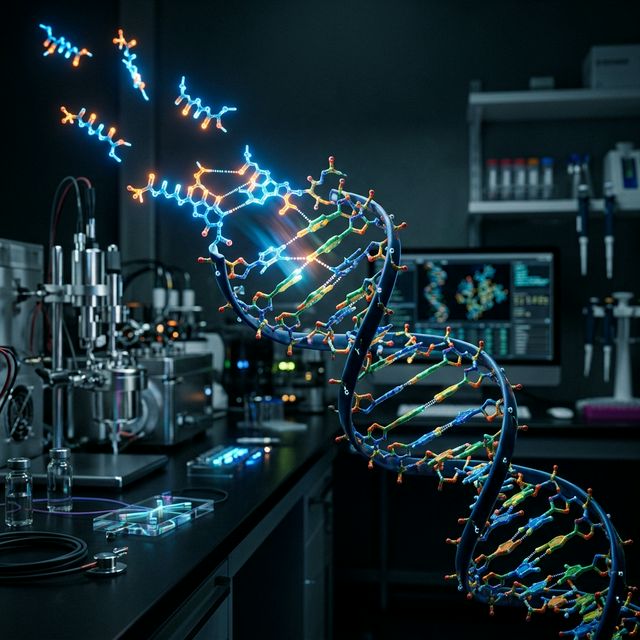
De novo synthesis of a custom genetic circuit using overlapping oligo pool fragments.
Key Facts
- •A 3 kb gene needs only 19-34 oligos depending on length (200 bp or 120 bp)
- •Multiple genes can be assembled from a single pool using gene-specific amplification primers
- •Overlap design: 20-40 bp for Gibson/PCA (Tm 62-70°C), 4 bp overhangs for Golden Gate
- •Error correction (enzymatic or selection-based) compensates for array synthesis error rates
Which Assembly Method Fits Your Construct?
| Method | Overlaps | Max Fragments | Best For | Error Handling |
|---|---|---|---|---|
| Gibson Assembly | 20-40 bp, Tm 62-70°C | 5-10 fragments | Standard gene assembly | Post-assembly sequencing |
| Golden Gate | 4 bp overhangs (BsaI) | 10-30+ fragments | Modular, scarless assembly | Sequence verification |
| PCA (Polymerase Cycling) | 20-30 bp overlaps | 20-60 oligos directly | Small genes (1-3 kb) | Error-prone; needs correction |
| Hierarchical Assembly | 2-stage overlaps | Unlimited (multi-step) | Large constructs (>10 kb) | Stage-wise verification |
Typical Fragment Counts for Gene Assembly
| Construct | Size | Oligo Length | Oligos Needed | Pool Cost |
|---|---|---|---|---|
| Single Gene | 1-3 kb | 150-200 bp | 10-35 | Contact vendor |
| Large Gene | 3-10 kb | 200-300 bp | 20-65 | Contact vendor |
| Pathway (3-5 genes) | 5-15 kb | 200 bp | 50-150 | Contact vendor |
| Gene Cluster | 10-50 kb | 200-300 bp | 65-320 | Contact vendor |
| Variant Library (100 genes) | 100-300 kb total | 200 bp | 1K-3K | Contact vendor |
Pricing varies by vendor and pool size — contact vendors directly for quotes. Excludes amplification reagents and error correction.
Checklist for Pool-Based Gene Assembly
Codon-Optimize Gene Sequence
Optimize for target organism codon usage. Remove problematic sequences: internal BsaI/BsmBI sites, extreme GC regions, homopolymers.
Use GC Analyzer →Tile Overlapping Oligos
Divide into 150-350 bp fragments with 20-40 bp overlaps. Equalize Tm of overlaps (62-70°C). Add unique amplification primer sites for each gene.
Use Tm Calculator →QC Oligo Sequences
Screen all oligos for synthesis problems: GC extremes, homopolymers, repeats, and hairpins. Redesign tiles around problematic sequences.
Use Batch QC →Order Pool & Amplify
Submit to vendor. After delivery, selectively amplify each gene's fragments using PCR with gene-specific primers. Gel-verify sizes.
Assemble & Verify
Gibson/Golden Gate assembly. Transform, pick colonies, sequence-verify. Apply error correction if needed (e.g., ErrASE, CorrectASE).
Use Error Rate Calculator →Frequently Asked Questions
How long of a gene can I assemble from an oligo pool?▾
What overlap length should I use between oligos?▾
How many oligos do I need to assemble a 3 kb gene?▾
Can I assemble multiple genes from one oligo pool?▾
Related Gene Assembly Pages
Design a CRISPR sgRNA Oligo Pool
Size knockout and CRISPRa/i guide pools, then run QC before ordering.
Design a Custom NGS Panel Oligo Pool
Plan hybrid capture or amplicon panels with probe counts and tiling rules.
Design a Mutagenesis Oligo Pool
Plan DMS and saturation libraries with explicit variants and balanced coverage.
Design an Oligo Pool Before Ordering
Review pool design constraints before finalizing sequence architecture.
Choose Between Array and Column Synthesis
Compare synthesis routes before setting length and pool-size assumptions.
Open Ordering Checklist
Check format, quantity, and delivery requirements.