NGS Panel Oligo Pool Design for Capture and Amplicon Probes
Use this page when you need to turn a target list into an order-ready hybrid capture or amplicon panel. Start with the main oligo pool guide first if you need the broader design, synthesis, QC, or vendor-decision sequence. It walks through panel sizing, probe tiling, Tm normalization, QC flags, and validation stepsbefore you order a custom NGS panel oligo pool.
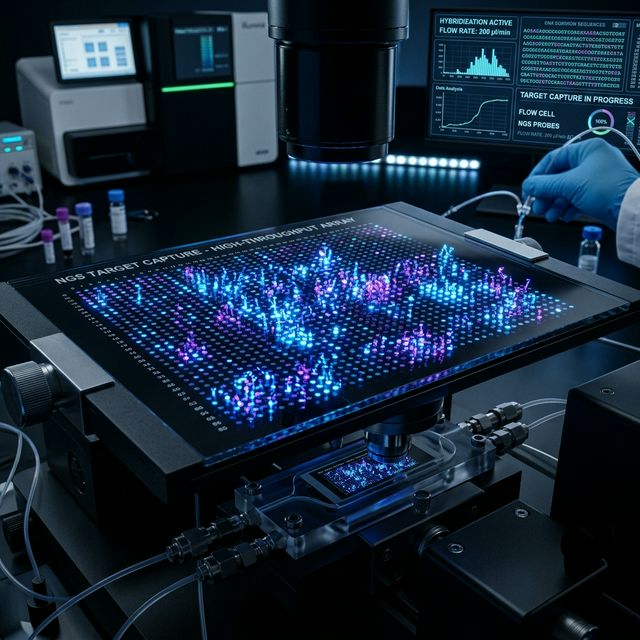
Hybridization capture probes isolating specific target sequences during NGS library preparation.
Key Facts
- •Custom capture panels require a one-time synthesis cost — become more cost-effective than pre-made panels after 10-20 reactions
- •Standard probe length: 120 bp with 2x tiling (60 bp overlap) for uniform capture
- •Panel sizes: 500-gene cancer panels (~10K probes) to whole-exome (~400K+ probes)
- •Key QC: On-target rate ≥70%, uniformity CV <3-fold, <5% zero-coverage targets
Capture vs. Amplicon: Which Panel Are You Building?
| Feature | Hybridization Capture | Amplicon-Based |
|---|---|---|
| Mechanism | Biotinylated probes hybridize to targets | PCR primers amplify targets |
| Oligos/Target | 2-4 probes (120 bp, 2x tiling) | 2 primers (20-30 bp each) |
| Target Size | Up to 50 Mb (whole exome) | Up to 500 kb |
| Uniformity | Good (CV <3-fold with probe rebalancing) | Variable (primer competition) |
| On-Target % | 60-85% | 90-99% |
| Input DNA | 50-200 ng | 1-10 ng (PCR-based) |
| Best For | Exome, large panels (>500 targets) | Small panels (<500 targets), low input |
| Oligo Pool Cost | Varies (contact vendor) | Varies (contact vendor) |
Typical Panel Size and Probe Counts
| Panel Type | Target Regions | Total Coverage | Probes Needed | Pool Cost |
|---|---|---|---|---|
| Hotspot Panel | 50-200 mutations | ~10 kb | 200-500 | Contact vendor |
| Targeted Cancer Panel | 50-500 genes | 100 kb-1 Mb | 2K-20K | Contact vendor |
| Comprehensive Cancer | 300-500 genes + fusions | 1-5 Mb | 20K-100K | Contact vendor |
| Whole Exome | ~20,000 genes | ~60 Mb | 400K-800K | Contact vendor |
| Custom Research | Variable | Variable | 500-50K | Contact vendor |
Pre-Order Checklist for Custom NGS Panels
Define Target Regions
Export BED file of target coordinates. For gene panels: exons ± 10 bp flanking. For regulatory: full regions of interest.
Use Coverage Calculator →Tile Probes Across Targets
120 bp probes with 2x tiling (60 bp overlap). Increase density for GC-extreme regions. Remove probes with >80% homology to off-target regions.
QC Probe Sequences
Screen for synthesis-problematic features: extreme GC (<25% or >75%), homopolymers, strong hairpins. Redesign or add extra probes for flagged regions.
Use Batch QC →Optimize Tm Uniformity
Target Tm = 65-75°C for hybridization capture. Adjust probe length (80-170 bp) to normalize Tm across panel.
Use Tm Calculator →Order & Validate
Submit to vendor with biotin modification (if capture). Validate panel behavior on appropriate control samples before downstream use.
Frequently Asked Questions
How many oligos do I need for a targeted NGS panel?▾
What probe length works best for capture panels?▾
How do oligo pool capture panels compare to pre-made panels?▾
Can I use oligo pool probes for both DNA and RNA capture?▾
Related NGS Panel Pages
Design a CRISPR sgRNA Oligo Pool
Size knockout and CRISPRa/i guide pools, then run QC before ordering.
Design a Mutagenesis Oligo Pool
Plan DMS and saturation libraries with explicit variants and balanced coverage.
Assemble Synthetic Genes from an Oligo Pool
Plan fragment overlaps, amplification, and assembly before synthesis.
Review Oligo Pool Design Rules
Check sequence constraints that commonly break probe synthesis or panel uniformity.
Compare Oligo Pool Vendors
Match panel scale, length tier, QC scope, turnaround, and quote terms.
Plan Oligo Pool Synthesis from Design to QC
Use synthesis planning when method trade-offs, quote planning, and QC thresholds shape the next decision.